
This post written by Jessie deHaan (M.Sc.), Research Technician in the Biocontrol Lab at the Vineland Research and Innovation Centre.
Recent collaborative research from Ontario Ministry of Agriculture, Food and Agri-Business (OMAFA), Agriculture & Agri Food Canada (AAFC), and Vineland Research and Innovation Centre (Vineland) has helped reveal some key components of Thrips parvispinus ecology and behaviour.
This has helped us to develop monitoring approaches for this pest in greenhouse floriculture, and is helping to point us towards optimized control strategies.
This research was covered in a recent webinar hosted by Flowers Canada Growers (linked to in the post below). But if you’d rather read than watch, this post summarizes our findings!
Why Study Pest Behaviour?
Professional athletes study their opponent’s match videos to learn about them and anticipate their moves; chess players and strategy game enthusiasts play to their opponent’s strengths to trap them; and the Chinese military general, philosopher and strategist Sun Tzu understood the importance of knowing one’s enemy and one’s own capabilities. From strategy games to professional sports to The Art of War, it’s clear that understanding your enemy is the first step in knowing how to beat them.
In this case, our enemy is a new thrips species, Thrips parvispinus (‘Parvi’). First detected in southern Ontario in 2021/2022, we quickly realized that our typical thrips controls, monitoring methods, and even host plants were not the same for Parvi as for western flower thrips (WFT) or onion thrips. So, we set out to understand our new foe.
Effective pest control depends on accurate identification and an understanding of the biology, ecology and behaviour of a pest to better control it. In Part 1 of the webinar series with FCG we learned about Parvi biology. Now we know a bit more about their specific behaviours in the greenhouse.
Watch the whole webinar on Parvispinus behaviour below, or keep reading for highlights!
1. Host Plant Preferences
Parvi can feed on a wide range of host plants (check out the current known host list) but in laboratory trials comparing bean, pepper and Mandevilla, Parvi showed the lowest preference for Mandevilla. Parvi oviposition was highest, and their life cycle time was shorter on beans – pepper came in second. Survival was lowest on Mandevilla (40%, compared to 75% on beans).
So other than being grateful we don’t grow ornamental beans, how does this help us? Well, it points us in the direction that if Mandevilla isn’t a good host for Parvi, Mandevilla also may not be a good host for thrips biocontrol agents. See more in Section 2, below!
In these experiments we also learned that in some varieites, Parvi tends to prefer younger leaves as their oviposition sites (Figure 1 – Grande Red), compared with older leaves on the same Mandevilla plant.
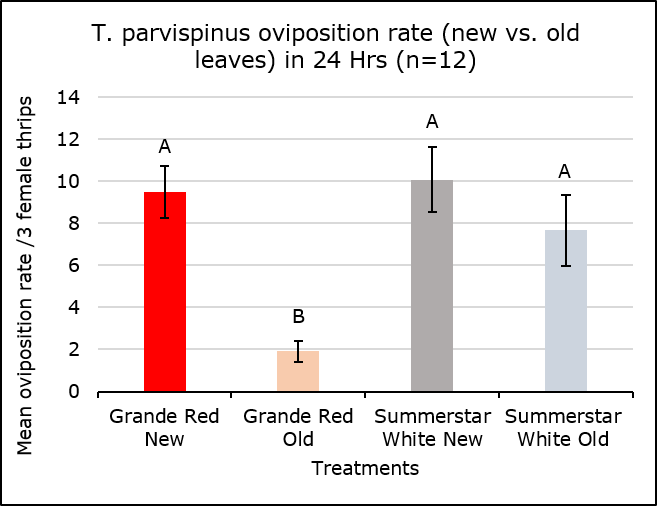
This backs up what we’ve been seeing in the field – in many plant species and varieties, growing tips tend to show damage first, which makes them a good place to focus your scouting. Even a small number of Parvi can cause severe damage or destruction of the growing tips, which are necessary for growth and trellising of Mandevilla.
Interestingly, in some varieties, Parvi chooses to oviposit in equal amounts on new AND old leaves (Figure 1- Summerstar white). On these varieties, thrips pressure is going to be higher, so both new and old leaves need to be targets for scouting.
2. How Does Host Plant Affect Predation?
To help determine why traditional thrips biocontrol programs aren’t working for Parvi that well, we first needed to look at predation rates. Maybe our predators just hate Parvi!
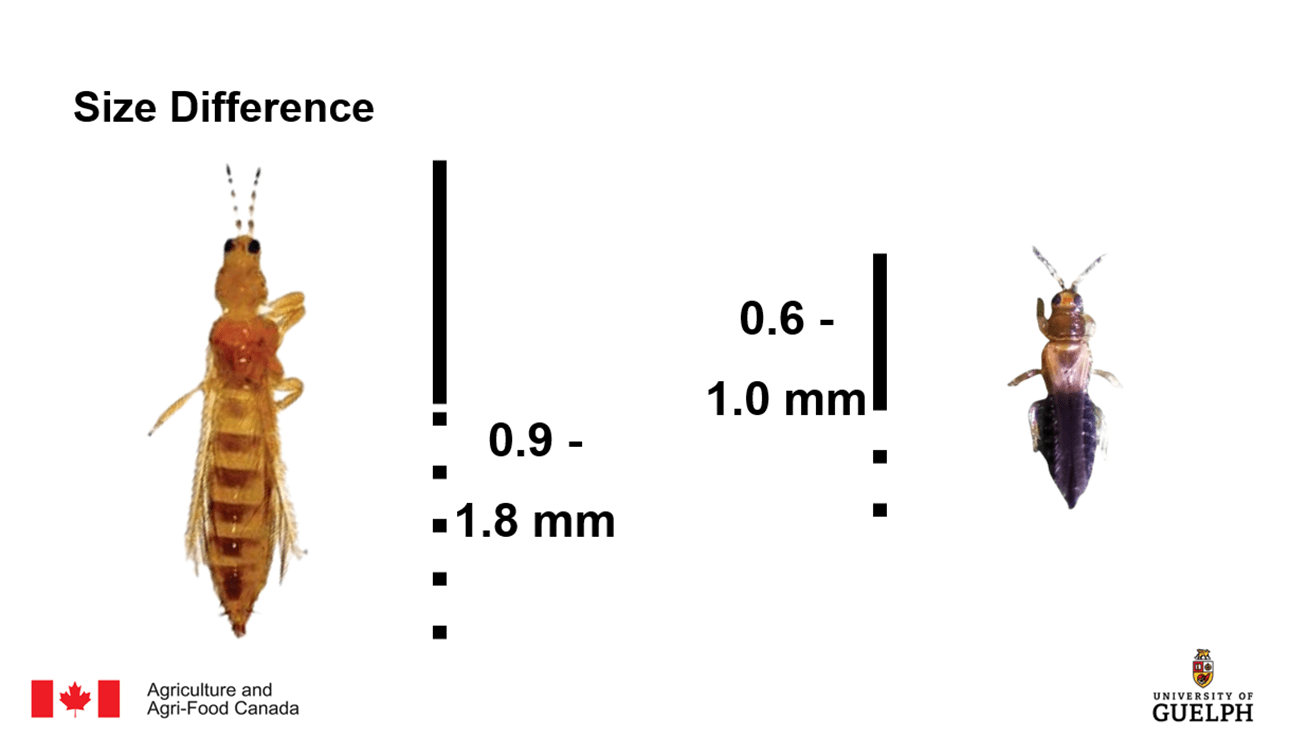
When we compared the suitability of T. parvispinus and WFT as prey for Orius insidiosus using peppers as a host plant, Orius consumed significantly more Parvi than WFT. This is likely due to Parvi’s smaller size, making them easier to handle (Figure 2). Orius showed no preference for Parvi or WFT infested host plants in scent-finding experiments on pepper, meaning Orius should be able to find Parvi just fine, too.
But let’s go back to host plant effects – if it’s not the pests themselves that’s mucking up biocontrol success, maybe it’s what they’re eating? So, we looked at predation of both Orius and Amblysieus swirskii on Parvi reared on beans or Mandevilla.
Interestingly, Orius showed lower rates of predation against 2nd instar Parvi when reared on Mandevilla compared to beans! Consumption of 2nd instar larvae and adults reared on Mandevilla was around 20% lower on this host plant. A biochemical analysis (metabolomics) revealed that Mandevilla-reared larvae have unique metabolites compared to those reared on beans, which may contribute to predator avoidance or reduced interest (i.e. they taste gross).
In contrast, A. swirskii showed no preference between 1st instar larvae reared on beans vs Mandevilla host plants, so there may be other reasons this predator doesn’t control Parvi on Mandevilla well. We’re currently looking into this.
3. Defensive Behaviour
Another reason biocontrol programs could be struggling with Parvi may have to do with the defensive behaviours of this pest. In general, thrips are known to evade predation by walking away or engaging in combative behaviours (aka “butt slapping) to deter mites. Check out this video of western flower thrips and N. cucumeris demonstrating this behaviour by Sarah Jandricic:
Preliminary results of an AI-driven insect tracking revealed that in the presence of A. swirskii, Parvi employ combative defenses more than WFT does. Parvi also run faster in the presence of a predatory mite versus when mites are not around. Vineland Research plans to compare these results across different leaf surfaces and different predatory mite species in the near future.
4. Flight Activity
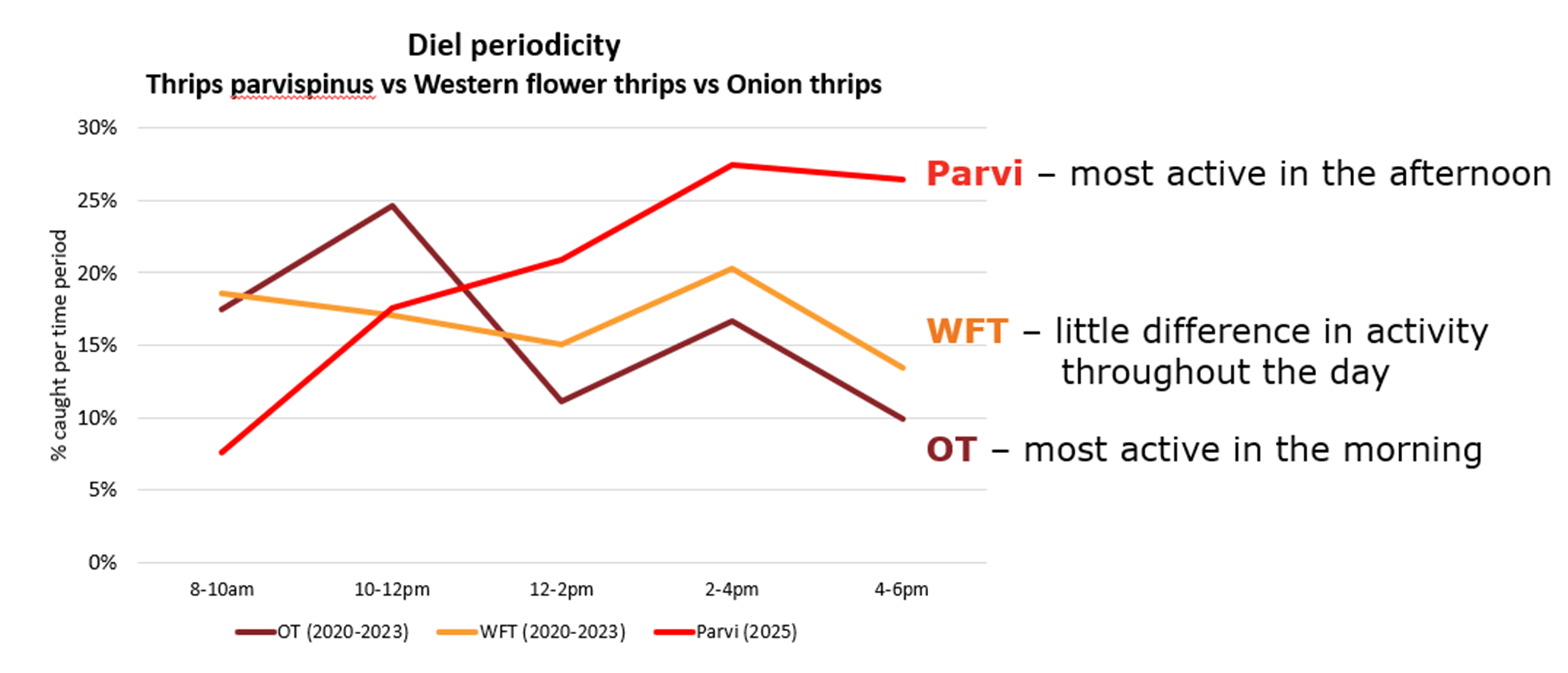
We also did experiments looking at Parvi activity throughout the day (formally called “diel periodicity”). We found that Parvi are afternoon-loving; their peak flight activity occurs between 2pm and 6pm. This is in contrast to OT, who prefer the morning, and WFT which are active all day (Figure 3).
When thrips species are most active can have implications for pesticide applications (see “Putting it All Together”, below). Additionally, Parvi also shows a strong preference for the side of sticky cards facing the sun, which may have implications for their mass-trapping.
5. Colour preference
We also looked into the optimal way to monitor for Parvi in the greenhouse. We compared card colours, to look for the best monitoring card. We also compared monitoring cards to other monitoring strategies: plant taps (which can be seen in this video), and plant washes (you can learn about this technique here).
Comparing yellow, blue and white sticky cards, the dark blue cards from Russell IPM significantly outperformed yellow cards in commercial trials in hibiscus. However, yellow remains the gold-standard for Western Flower Thrips. This confirms previous data by OMAFA showing dark blue cards were most effective for Parvi in other greenhouses and tropical crops, including Schefflera and Mandevilla.
But remember, cards only track populations of adults; they do not provide accurate early detection or give an indication of the number of larvae present. Our trials showed that plant taps also revealed adults, but counts were not that much different than putting up a monitoring card (Figure 4) for a week, which is less labour intensive.
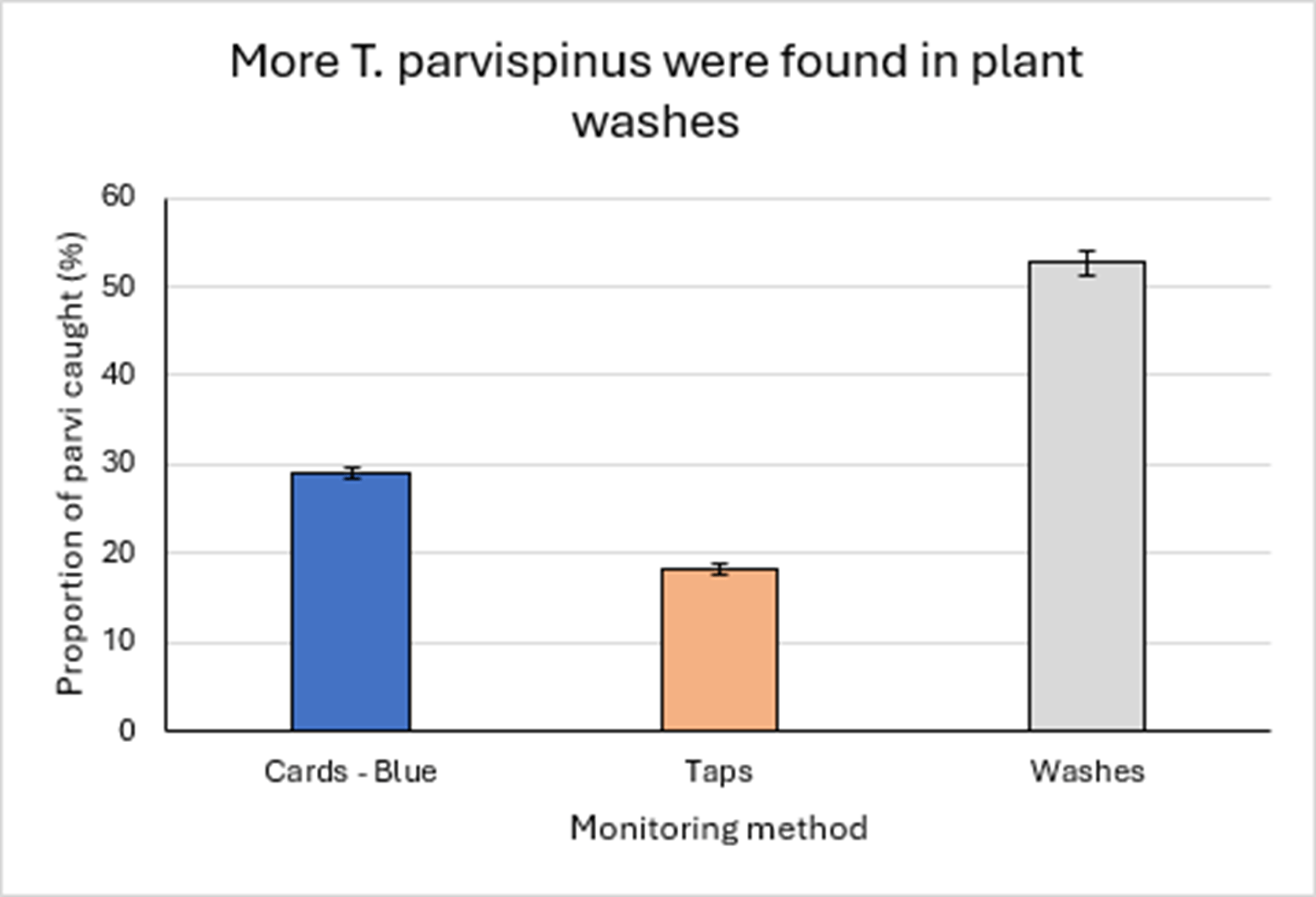
We were hoping taps would give a better sense of both adults and larvae in the crop, but unfortunately, we saw few/no larvae. It seems that Parvi tend to hold onto the plant tighter than WFT! Ultimately, plant washes were the gold standard for accurate population estimation (Figure 4) – including adults and larvae – even though it’s quite labour intensive.
Putting it All Together- Monitoring Recommendations
Now that we have a basic understanding of Parvi biology and it’s ecology in Ontario greenhouses, we can start to formulate a plan of attack when it comes to monitoring:
- Differences in host crop preferences and thrips life cycle timing/success mean you should focus your scouting efforts on the most susceptible varieties. Make sure to check both top and bottom leaves of these varieties. But don’t forget to also walk the rest of your crop regularly to look for damage on growing tips!
- Plant taps aren’t really worth it as a monitoring method for Parvi, since Parvi larvae stick to the plant like Velcro, and taps are time consuming.
- Plant washes are ideal for accurate population counts and assessments of spray efficacy, but they are labour intensive. Washes also require a microscope (see the guide!).
- Plant washes should be used to confirm the presence of Parvi if you’re seeing early damage. They can also be used to tailor your pesticide active ingredient to the life stage you find most of (larvae or adults).
- Sticky cards are a low cost and effort way to monitor for Parvi. To optimize this strategy, use dark blue cards
- Cards should not be used alone, as they only show adult thrips. Growers should walk their crop frequently and look for tip damage (twisting leaves), a sign of oviposition or larval feeding.
- To get the most out of monitoring cards, make sure to place sticky cards facing the afternoon sun, not just where it’s convenient in your greenhouse.
Pest Management Insights
In terms of these results informing pest management, there’s also a few tidbits here:
- Based on the oviposition diffferences we saw on different Mandevilla varieties, consider dropping highly susceptible varieties . This will help to reduce some of the “source” populations in your greenhouse – or at least reduce the number of thrips you need to deal with.
- If you do keep susceptible varieties, where Parvi is known to prefer both top and bottom leaves equally, you’ll need good pesticide coverage on the entire plant, to make sure you aren’t missing part of the population.
- To ensure good contact with Parvi, be sure to use contact insecticides and biopesticides in the late afternoon. Our results of Parvi flight activity show this is when adults are most active and likely to be exposed.
- Use large dark blue cards for mass trapping Parvi – you can make sure these are facing the afternoon sun to boost catches.
Some of the information we collected here, like how host plant affects predators, will feed into biocontrol solutions for tacking Parvi. Our 3rd webinar and its blog summary will be posted shortly detailing IPM solutions for Parvi, so stay tuned!
One thought on “Thrips parvispinus: Know Thy Enemy‘s Behaviour”