
This post was written by Kendra van der Wier, Greenhouse Floriculture Summer Research Student for OMAFA.
Parts 1&2, written by Dr. Sarah Jandricic, covered why to trap and when, as well as ways to improve mass trapping by choosing the right colour and placement.
This post covers my summer research project looking into the utility of thrips lures. What kinds of lures are there, and do they work on multiple thrips species? And are they worth the extra expense?
This post helps answer these questions for 2 common pest thrips species – western flower thrips and onion thrips.
Stay tuned for more work on lures for mass trapping Thrips parvispinus, another aspect of my research project.
Inside This Post:
Different Types of Lures for Thrips
There are 2 types of thrips lures on the market. The first type is based on sex aggregation pheromones from western flower thrips – so this type of lure only works on this species. Examples of this include Biobest’s ThriPher lures (not pictured).


Figure 1. Two examples of kairomone lure types on the market. Koppert’s Lurem-TM lure (left) and Russell IPM’s Thripnok lure (right). Photo by OMAFA.
The second type are based on plant chemicals that are attractive to thrips. These types of attractants are called “kairomones” instead of “pheromones”. Examples include Koppert’s Lurem-TM and Russell IPM’s ThripNok (sold by Plant Products in North America). Because they are less specific, they can potentially attract a wide variety of thrips, not just western flower thrips.
The Lurem lures comes as individual dispensers that just need to be popped open and hung on a sticky card (Figure 1, left) while the ThripNok comes as a gel in a tube applicator. The gel should be placed as a 1cm blob in the centre of the card (Figure 1, right).
For now, we are going to focus on kairomone lures, since we think they have wider utility, potentially being attractive to several species of thrips.
Do Lures Work? How Well?

We had to opportunity to test kairomone lures in stock geraniums in a commercial greenhouse that had developed a healthy population of thrips.
In 2024, trials were run by OMAFA and Vineland Research, testing Koppert’s Lurem lure only. They ran 2 back-to-back trials: a trial from October to April (when no thrips would be flying in from outside), and a spring trial (which could include thrips coming from outside) from April to May. They set up 2 mass trapping cards in 6 blocks within the greenhouse: a Lurem-TM lure and no-lure card.
In 2026, OMAFA conducted similar tests with the addition of the Russell IPM ThripsNok lure. Trials were run in April and May. Each month, we set up 3 mass trapping cards on 6 benches within the greenhouse and randomized the treatment type: a Lurem-TM lure, a Thripnok lure, and a control card (Figure 2). These were placed every 9m down the benches.
In all cases, we used the 40×20 cm Horiver yellow mass trapping cards from Koppert, as this is the brand the grower was already using. In both experiments, results were compared to see how effective the lures were in increasing thrips catches on cards. In the 2024 trial, only Wester Flower Thrips (WFT) were found on the cards. In 2026, we found WFT and Onion Thrips (OT) on the cards.
Results – 2024 Lure Trials for Western Flower Thrips
To interpret our data, we took the number of WFT caught on either the control card (no lure), or the lure card, and divided it by the sum of WFT caught on each bench. This gave us the relative proportion of thrips caught on each card type. We did this for each greenhouse bench and calculated the averages (Figure 2).
We used proportions rather than raw numbers due to the high variability in thrips numbers per bench. The front of the greenhouse, near doors, or close to vents, were hot spots for WFT. Geranium variety also affected thrips numbers. We didn’t see a difference in trends in the Fall versus Spring trials, so we pooled the data together.

Figure 3 shows the average proportion of WFT caught with the Koppert lure versus the no-lure (control) card. Overall, the Koppert lure card performed well, with 62% of the thrips population in the compartment caught on Koppert cards, on average, compared to 36% on the control cards. This means there was a 70% relative increase in the WFT caught when the lure was used! (Relative increase being how much something increased compared to it’s starting size).
Hypothetically, if you had a 20,000 sqft area and set up 10 sticky cards with no lure, you may trap around 2400 WFT per week in the compartment, using the averages from our experiments. BUT if you set up 10 sticky cards adding a kairomone lure, you could catch up around 500 more thrips per week. Additionally, every female thrips caught potentially removes 300 new thrips (eggs) from your growing area!
You may have noticed the small cursor-like lines above the results for each treatment. These are standard error bars, which show how much the sample average is expected to vary from the population average. It’s essentially a measure of “noise” in the experiment. The smaller the standard error bar, the better, meaning “noise”, like bench position, geranium variety, etc., don’t effect the lure treatments that much.
Overall, we can conclude that the Lurem lure significantly increases the number of WFT caught on mass trapping cards, and that this result was consistent across seasons.
Results – 2026 Lure Trials for Western Flower Thrips and Onion Thrips
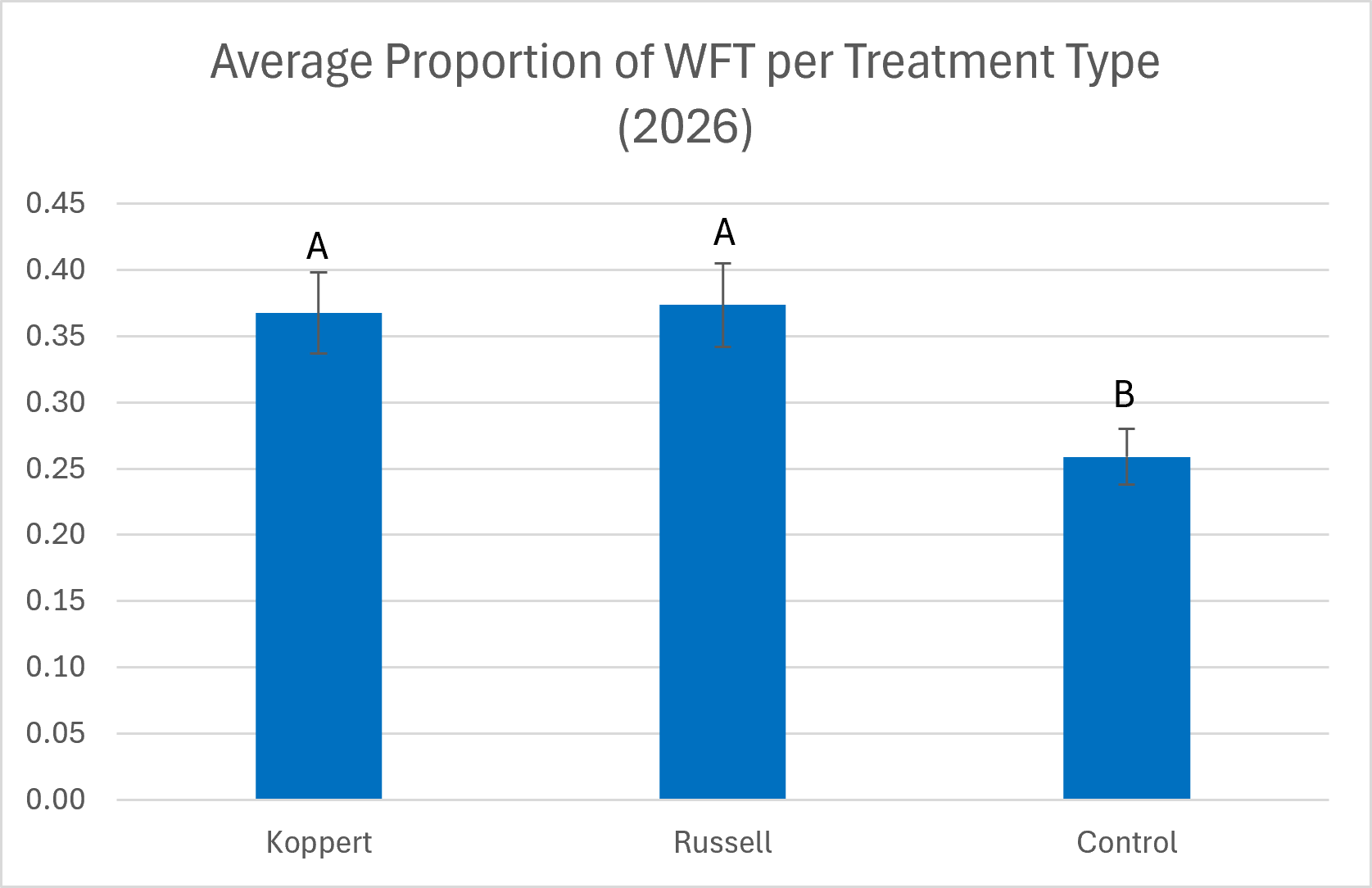
Results in 2026 were similar to 2024, but in this case, the Thripnok (Russell IPM) lure also caught a higher proportion of the WFT than control cards (Figure 4). The Russell lure showed a 44% relative increase in proportion of WFT caught compared to the control card, while the Koppert lure showed a 42% relative increase. Note that had a single lure type been used, the result of the lure probably would have been even higher – the Thripnok and Lurem lures were splitting the vote!

In addition to WFT, OT were also caught in the 2026 study. However, no significant differences were observed between lure and no lure card catches.
In our case, we either didn’t have enough OT to make sense of this data (too much noise), or OT may just not be attracted to the lures as strongly as WFT.
However, previous data by Ashley Summerfield (Vineland Research and Innovation Centre) saw a much greater attraction of OT to the Koppert lures (>250%) compared to control cards. Although this trial was done in a research greenhouse with VERY high OT pressure, these results are obviously very encouraging! We have other data with WFT and OT we are currently analyzing, so we hope to update you a bit later.
What About Costs?
Let’s break down the cost (including tax) of setting up mass trapping for both lure types:
- Sticky cards: one pack (12 cards) of yellow 25×40 cm Hovier Koppert sticky cards costs around $22. Depending on how dirty the cards get, each card can last 12 to 16 weeks.
- Koppert Lurem-TR: a box of 20 lures costs around $150. To be effective, lures should be replaced every 6 weeks and placed on cards every 100m2.
- Russell Thripsnok Gel: a 30ml tube of gel costs around $24. At a standard rate of applying a 1cm blob in the center of the sticky card, you can get 30 applications out a tube. Gel should be reapplied every 2-3 weeks and placed on sticky cards every 100m2.
- Labor: assuming that it will take approximately an hour to prepare and hang the sticky cards each time they need to be replaced, total labor would cost $17.60 an hour (current minimum wage).
Let’s say we were working with a 1500 m2 (16,000 sqft) area. We would be using 15 sticky cards, lures for each of them, and accounting for minimum wage labor costs. For a 6-week period, the Lurem lure method would cost around $160. Alternatively, using the Thripnok lures for 6 weeks would cost $117.00.
Although the Koppert lures are pricier, you save time changing lures only once every 6 weeks compared to the Russell lure. Since IPM measures sometimes fall through the cracks when things get busy in the greenhouse, ask yourself how likely you are to task someone with adding a new lure every 2 weeks vs. 6 weeks. No lure will be effective if you forget to put it out!
If you don’t want to spend the extra money on the standard amount of lures, adding a couple lures in high-pressure areas can still be very beneficial and reduce the spread of WFT.

Will Attract Thrips INTO My Greenhouse?
Going back to Ashley’s results with lures and OT at the Vineland Research Centre, she also looked at the optimal distance needed for Lurem lures to be the most effective in catching OT.
Basically, the card with the lure, as well as cards placed 2m from the lure both saw a huge boost in OT caught. However, cards at the end of the bench (15m) didn’t.
This is similar to the preliminary results in our geranium trials with WFT, where we looked at control cards only every 9m, versus alternating control vs. lure cards. We didn’t notice a “bump” of WFT on control cards when a lure was placed 9m away, which confirmed this was a good set up for our trial. So, if you’re nervous, you can put the lures down the centre benches of your greenhouse, away from side vents or outside doors.
Additionally, thrips flying in from outside are a major source of thrips already, so we might as well find better ways to intercept them BEFORE they attack your crop.
What Rate of Lures Should I Use?
Considering that each greenhouse is likely going to vary in it’s optimal lure density, based on fan speeds, venting, and other airflow factors, it’s best to follow the manufactures’ details. However, when we look at Ashely’s data, we can conclude that, if you are in a pickle, using more lures closer together will likely increase catches.
Take Home Message
In the first blog post of this series, we established that mass-trapping thrips is extremely beneficial and comes with perks such as reducing foliar and flower damage and taking pressure off your biocontrol programs. In the second blog post, we talked about the importance of sticky card colour, placement, and duration. Now, at the end of this blog series we have discussed what types of thrips lures are on the market, if they make a difference, and their costs. So, when it comes down to it, is it worth using Kairomone lures?
- From our previous research, we know that thrips fly into your greenhouse at higher rates between late May and late September, peaking in mid-July. Coupled with higher temperatures speeding up thrips reproduction, this can lead to your biocontrol program being overwhelmed. We’ve seen more evidence of this happening in Niagara as weather tends towards warmer springs, especially if sales are slower in late May and crops sit for longer.
- Using kairomone lures can increase thrips catches up to 70% compared to using mass trapping cards alone. As thrips IPM is about layering preventive strategies, any boost in thrips catches can act like an insurance policy against spring thrips taking off in your greenhouse or summer thrips fly-ins.
- Both the Koppert and Russell lures are effective for WFT when used for mass trapping. Would you prefer hanging lures once every 6 weeks or can you do it every 2 weeks? Pick the lure type that is best for your operation.
- Remember that pheromone lures are specific to one type of thrips, so make sure you know what you have in your greenhouse BEFORE using these. When in doubt, kairomone lures may make the better choice for mixed populations of WFT and OT. We still don’t know how other thrips species (Parvispinus, Japanese flower thrips, etc.) respond to these, so you may need to do some tests in your own greenhouses.
So, should you use lures for effective mass trapping? The answer is definitely yes, especially if you find yourself struggling with thrips control during late spring or summer.
Questions about this research can be directed to Dr. Sarah Jandricic at sarah.jandricic@ontario.ca.