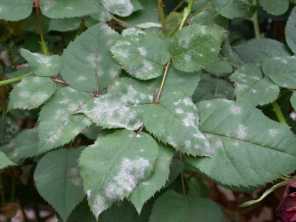
With May’s weather continuing to be up and down, humidity control is a problem in the greenhouse, meaning Powdery Mildew (PM) is too. This pest is rearing it’s ugly head in crops like Kalanchoe and Dahlia.
We won’t cover the basics of PM here: biology, spread and prevention were covered in a previous post. Instead, we’ll focus on monitoring, and which control products to use once you’ve found an infection.
This post was written with help from Plant Pathologist Ann Zemke of the Chase Research Group.
Although native bees and honeybees may just be starting to gather strength and are beginning to fly outside, other “B’s” have been of growing concern in the greenhouse for some time now.
These include common spring bedding crop problems like Botrytis cinera (aka grey mold), Broad mites, and leaf burn (from a variety of causes).
Keep reading for tips on how to manage these issues during this time of year.
Wilting of a poinsettia plant on a bench of otherwise healthy plants could be Pythium root rot. But then again, it might not…
From now until mid-November is when you’ll most likely see plant losses in poinsettia due to severe wilting. These losses can be considerable: anywhere from 2-15% in Niagara operations in past years, with disease pressure seeming especially high this year.
Pythium may be considered the most “likely” culprit in Poinsettia in this area, but this isn’t always the case, and misdiagnosis can mean wasted fungicide applications. Read on for a list of likely suspects and appropriate control measures.
With the intense period of rain we just had, and with MORE rain coming on Friday, it’s time to think about Botrytis control and prevention. One of the most common and destructive diseases of greenhouse crops, outbreaks usually follow periods of cool, damp, cloudy weather. Unfortunately, I can’t order up more sun for you, but I CAN suggest some management tactics.
It’s that time of year again, when baskets of Million Bells (Calibrachoa) are going up in the greenhouse. Here’s how to deal with and prevent some of their most common issues.
Iron deficiency in Calibrachoa. The resulting yellowing can look similar to symptoms caused by black root rot or nitrogen deficiency.
From a nutritional standpoint, the best thing you can is keep the pH of your calibrachoa in its ideal range; between 5.5 and 6.0. A pH higher than this can inhibit nutrient uptake, especially micronutrients such as iron.
Iron deficiency can be difficult to distinguish from other issues (like Black Root Rot – see below), but typically leads to yellowing of new growth. Leaves may only show chlorosis between the veins, or it may be spread throughout the leaf. This is different from nitrogen deficiency where yellowing occurs in the oldest leaves. If iron deficiency occurs, adding a chelated form of iron is best for uptake.
Yellowed plant growth (yellow circle) and dead plugs (orange circle) on a plug tray of Callibrachoa from black root rot.
Million bells are also highly susceptible toBlack Root Rot (Thielaviopsis) – I’ve seen this take out a good chunk of a crop. Symptoms include:
Stunting of foliage and roots
Plants in a tray will have uneven heights
black areas on roots
yellowing of leaves
Prevention is worth a pound of cure with this disease, as it is difficult to eradicate once established. Important steps to take include:
Proper Sanitation. To avoid an issue with Black Root Rot year after year, immediately dispose of diseased plants, limit water splashing, and sanitize benches, floors and used pots/plug trays. Always physically wash surfaces with a cleaner to remove organic matter, then follow up with a disinfectant such as KleenGrow (ammonium chloride compound).
Consider prophylactic applications of fungicides onplug trays. Products include Senator (thiophanate-methyl) or Medallion (fludioxonil). Preventative applications are an especially good idea if you’ve issues in the past. Adding bio-fungicides containing Trichoderma harzianum(e.g. Rootshield, Trianum) may also help.
Lowering your pH. This diseaseis significantly inhibited by a lower pH – between 5.0 and 5.5.
Manage fungus gnats and shoreflies, since these insects can spread Black Root Rot between plants. Treatments include nematodes, Hypoaspsis mites , or applications of Dimiln (diflubenzuron) or Citation (cyromazine).
If already established, rotated applications of Senator and Medallion may limit Black Root Rot, but are unlikely to cure it.
Aphids tend to be found on flowers and new growth of Calibrachoa.
Lastly, Million Bells are highly attractive to aphids. With baskets hung up in the greenhouse, they can be “out of sight, out of mind”, but regular monitoring is needed to prevent large aphid outbreaks. Place sticky cards directly in baskets, and routinely check plant material for aphid cast skins and honeydew.
Once aphids are detected (and they will be!), applications of Beleaf (flonicamid), Enstar (kinoprene) or Endeavor (pymetrozine) will usually take care of them. However, be aware that all of these insecticides take around 4-5 days to start causing aphid death.
It’s that time of year again, where the struggle against pests of poinsettias is real. So I thought it was time for a summary of what’s working in the industry, and what’s not. (Beware! This is a longer post than usual!).
Whitefly:
It’s no surprise that the biggest pest issue in Points is still Bemisia whitefly.
Bemisia whitefly on poinsettia.
For those of you relying on pesticides as your tool of choice, it’s time to cross your fingers and hope you’ve mostly got the less-resistant “B” species of Bemisia (click here for background on “B” versus “Q” ). Against “B”, you may see results with chemicals like Distance (pyriproxifen) and Kontos (spirotetremat). Dyn0-Mite (pyridaben) will also provide rapid knockdown of adult whiteflies only, so it can be used for crop clean-up.
But if you happen to have mostly the “Q” (or Mediteranean) species, you are pretty much out of luck when it comes to pesticides, except, perhaps, for Dyno-Mite. “Q” is generally thought to be resistant to all our registered products for whitefly. “Q” isalsoimpossible to distinguish from “B” without genetic testing, so you won’t know you have it until your spray program fails.
Given this, biological control really is your best option for whitefly control, at least until mid-October. Why? Because, inthe absence of pesticide pressure, “B” will gradually displace “Q” over the growing season (population genetics, baby!). This means that crop clean-up with chemicals near the end of the season will have a chance of working, as long as you don’t start it too early.
Bemisia whitefly (left) and greenhouse whitefly (right).
But even with biological control, the pest-control gods refuse to favour us. One of our best weapons against Bemisia – the parasitoid Eretmocerus mundus – is no longer available in Canadaas of this year. So, we’ll have to rely on the less-effective parasitoid Eretmocerus eremicus. You’ll also want to co-release Encarsia formosa, since these will control any greenhouse whitefly that come into the greenhouse. Encarsia will also do a bit of parasitising and host-feeding on Bemisia.
Bemisia whitefly parasitized by Encarisa (top, blackened pupa), versus one that’s been parasitized by Eretmocerus (bottom, yellowish pupa).
With E. mundus gone, some growers are avoiding parasitoids altogether and trying Amblyseius swirskii and/or Amblydromalus limonicus. Although these mites do eat whitefly eggs and crawlers, research at Vineland by Dr. Rose Buitenhuis has shown that A. swirskii are less effective for whitefly control than E. eremicus. So, I wouldn’t rely on these guys alone. But, they may have a place alongside other whitefly biocontrols, such as sprays of Beauveria bassiana.
I’d also be remiss if I didn’t mentionDelphastus catalinae. This predator seems REALLY effective for our friends on the West Coast. However, we’ve historically had less luck with it in Ontario. Given their compatibility with whitefly parasitoids (they don’t attack parasitized whitefly), their use within whitefly biocontrol programs may be worth re-visiting. But they may not establish unless you’ve got a moderate whitefly population already, and they are very sensitive to pesticide residues.
Ultimately, the trick will be finding the right combination of natural enemies to replace the job of E. mundus. This is why Graeme Murphy (you remember him???) and I are also looking at the potential for the generalist predator Dicyphus hesperus to aid in whitefly biocontrol programs. I’ll keep you posted on our results.
Lewis Mite:
Lewis mites (Eotetranychus lewisi) . Photo courtesy of the University of Maryland.
Lewis mite (a species of spider mite) can be a real problem in Poinsettia around mid-October, when populations have built up enough to start noticing damage. Early detection is difficult, since the symptoms are rather subtle at first: faint speckling and chlorosis (click for a link to pictures). If left unchecked, the upper foliage will turn brown and the mites will form unsightly webbing.
Webbing caused by a severe infestation of Lewis mite. Photo courtesy of Ohio State University.
Given that they are difficult to detect, many growers are turning to preventative applications of miticides. These include Avid (abamectin), Floramite (bifenazate), Vendex (fenbutatin oxide), Shuttle (spinosad) or Forbid (spiromesifen). This is usually done at the cutting stage, however. Control of Lewis mite with pesticides is more difficult now that the poinsettia canopy is filling in, since Floramite, Vendex and Shuttle are all contact miticides. Applications of more systemic miticides at this point (like Avid and Forbid) may interfere with your biocontrol program for whitefly, since they can be hard on parasitoids or predatory mites.
If you haven’t already treated for Lewis mite, walk your crop a little more often and look for the characteristic stippling symptoms. Look for mites on the underside of these leaves. Lewis mite is often confined to a particular cultivar or spot on the bench, so consider throwing out infested plants, or simply do a spot spray of miticides. If you need to spray more than once, remember to rotate chemicals to avoid resistance.
There are also some biological control options for this pest, one being the predatory midge Feltiellae. But, at this time of year, the midge is starting to enter diapause, so it likely won’t be active enough to give you control in time. However, you might see some control with releases of the spider mite specialist Phytoseiulus persimilis.
Pythium root rot:
Now that the plants are off the misting bench, our focus turns from Erwinia to Pythium root rot.
Wilting on a bench of otherwise healthy plants suggests Pythium root rot.
Brown roots on a wilting plant is indicative of Pythium infection.
The old standby chemicals for Pythium, including Subdue (metalaxyl), Truban (etridiazole) and Previcur (propamocarb hydrochloride), still usually work for Ontario growers – but this may not be true forever. Many growers in the U.S. have been encountering fungicide-resistant Pythium strains, especially with regards to Subdue. Because of this, many growers in California have starting applying microbial fungicides at the cutting stage to boost root growth and prophylactically help prevent disease — something to think about for next year.
Additionally, Dr. Anissa Poleatewich (Vineland) and I are running a commercial trialto see how drenches of microbial fungicides measure up to traditional chemicals for Pythium control over the season. Keep your fingers crossed that we get some good data to share!
Whew! That was a long one! And I STILL probably didn’t cover everything! Feel free to call or email to discuss issues not addressed in this post. Commenting below on what’s working and what’s not for your particular operation is also encouraged.
Sorry for the back-to-back posts, but I thought those of you growing chrysanthemums would be interested in this post from MSU on recognizing Tomato Spotted Wilt Virus symptoms in your crop.
TSWV is vectored by thrips. With temperatures between 25 and 28 C for the next 10 days, thrips reproduction will be rapid. Control of thrips (and elimination of infected plant material) is necessary to reduce virus spread.
Thrips biological control can be achieved in floriculture greenhouses using the predatory mite Amblyseius swirskii and/or A. cucumeris in combination with the parasitic nematode S. felitiae and foliar applications of BotaniGard. Registered chemicals for thrips in Ontario include:
Diagnosing a plant with vague symptoms likewilting, yellow and stunting is much like being a “plant detective”. First, you need to profile the “victim” — here, Callibrachoa plugs. Then, collect DNA evidence. Finally, use knowledge and instinct to narrow down your “suspects”. Only then can you come up with a plan to stop the assailant.
Yellowed plant growth (yellow circle) and dead plugs (orange circle) on a plug tray of Callibrachoa.An unhealthy plug; few white roots are visible.
In this case, our DNA evidence (c/o UofG Lab Services) gave me 3 possible suspects: Pythium disotocum, Fusarium oxysporum and Thielaviopsis basicola. But which of these was the real culprit?
P. disotocum is rarely documented as an aggressive pathogen in flowers, so we can eliminate that. Similarly, Fusarium is often “around” at low levels without causing a problem. But, T. basicola, better known as Black Root Rot, is a common problem in Callibrachoa, specifically. Rotting roots are not always directly evident (even under a microscope), but severe discoloration of the foliage is a good clue, since this pathogen produces toxins that result in yellowing. Left unchecked, Black Root Rot causes severe stunting and plant death.
Luckily, there are treatments for Black Root Rot, and preventative measures that can be taken.
A fungus gnat (left) and shorefly (right) caught on a yellow sticky card. Both of these pests can transmit Black Root Rot and other pathogens.
Drenches of Senator 70 WP (thiophanate-methyl) are the best option for dealing with an existing outbreak of Black Root Rot
Black Root Rot is often transmitted by fungus gnats and shoreflies. Management of these insects is key to prevention. They can be controlled with soil applications of nematodes, predatory mites (e.g. Hypoaspis), or insect growth regulars like Dimilin (diflubenzuron). These products are compatible with biocontrol programs for other pests, like thrips and aphids.
A high soil pH encourages the growth of Black Root Rot. pH should be kept below 5.6.
Bio-fungicides containing the beneficial organism Trichoderma harzianum (e.g Rootshield) can help protect plants from this Black Root Rot if applied at planting.

 Although native bees and honeybees may just be starting to gather strength and are beginning to fly outside, other “B’s” have been of growing concern in the greenhouse for some time now.