

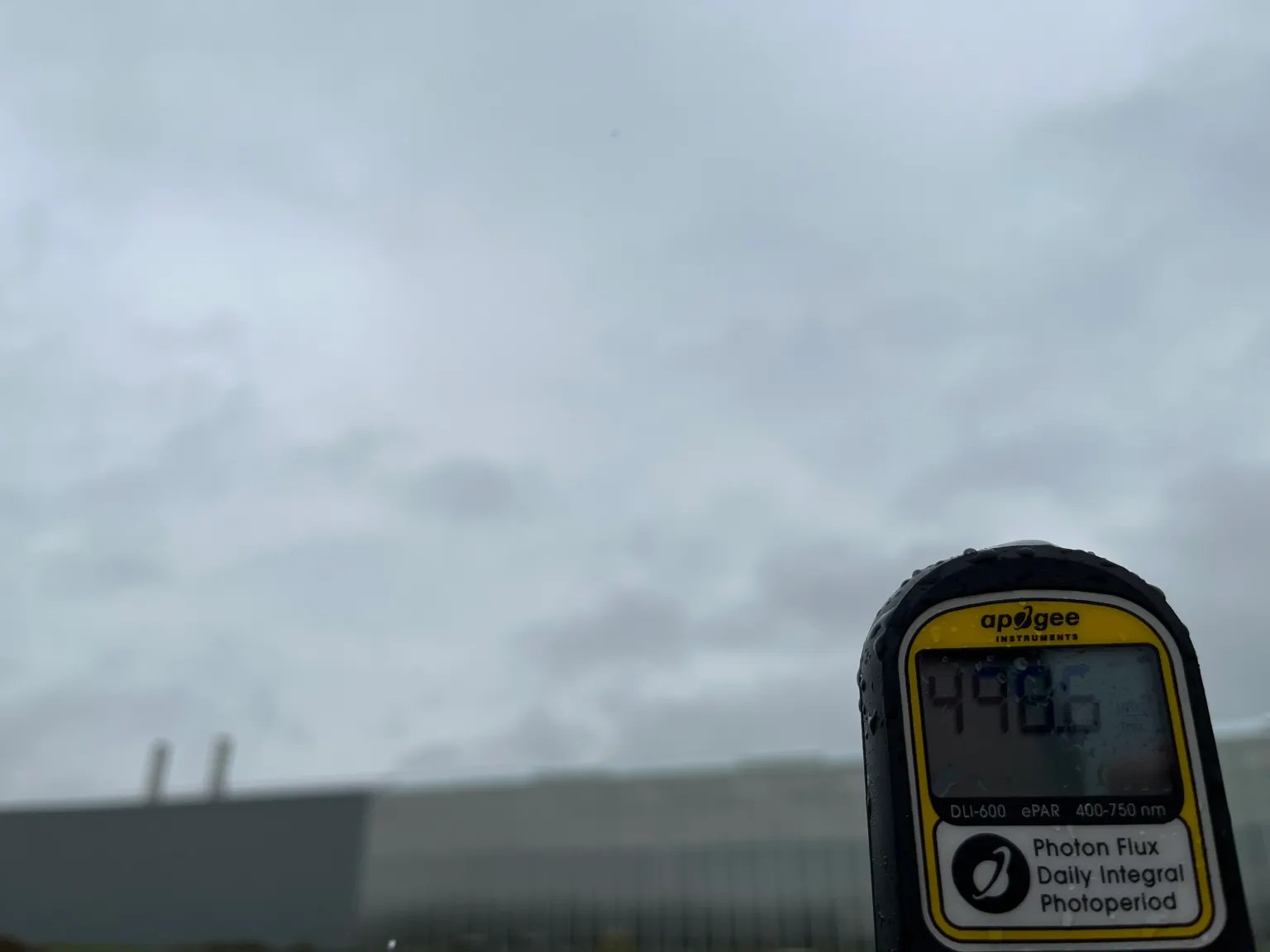
Did you notice lower light levels in September in the Vineland and Leamington-Kingsville areas? So did we, so read on to find out more!
Only looking for certain information? Use the table of contents to navigate between sections:
Summary
Vineland and Leamington-Kingsville experienced less light in weeks 37 and 38 than the same time last year.
Overall, the average DLI for the month of September for Leamington-Kingsville was 30 moles/m2/day. This was 32% less than September, 2025 and 23% less than September, 2024. In fact, September 2026 light levels were similar to those in October of last year. The maximum DLI was 53 recorded on September 9th, and the minimum DLI was 10 recorded on September 21th.
For the first time since we started monitoring light levels in Vineland last year, it received more light than Leamington-Kingsville, 20% more to be exact. The average DLI for Vineland in September was 36 moles/m2/day. This was 18% less than September, 2025. The maximum DLI was 52 recorded on September 9th, and the minimum DLI was 12 recorded on September 23th.
Tune in on the second Tuesday of each month at 12:00 pm during the Noon Farm Show on CFCO Country 92.9, covering Windsor to Woodstock. Not in the area? You can listen live online at country929.com.
Background
We mounted a daily light integral (DLI) meter on the border of Leamington and Kingsville, Ontario, in 2024, and another DLI meter at the Vineland Research and Innovation Centre (VRIC) in Vineland, Ontario, in 2025 to give greenhouse producers in those areas access to readily available light data.
The details of the Vineland data are available on this blog. If you are interested in the Leamington and Kingsville data, you can download the excel sheet at the bottom of this post and check out the ONGreenhouseVegetables blog.
Daily light integral (DLI) and photosynthetic photon flux density (PPFD) data are important to greenhouse production because they measure the amount of light that is available to the crop. This data can be used to adjust the growing environment, such as irrigation and carbon dioxide levels, to optimize photosynthesis and crop yield.
DLI is the total amount of light within the photosynthetically active radiation (PAR) spectrum (light wavelengths of 400-700 nm) that impacts a surface in a day. It is measured in moles per metre squared per day (mol/m2/day).
PPFD is the total amount of light within the PAR spectrum that impacts a surface every second. It is measured in micromoles per metre squared per second (µmol/m2/second).
The data provided here reflects the amount of outdoor light. The amount of light that greenhouse crops receive inside a greenhouse can be significantly lower (90-50%) and is affected by the cover material (clear glass, diffused glass, single polyethylene, double polyethylene, triple polyethylene, etc.), cover material treatment (whitewash), and curtains (shade, energy, blackout, etc.). The ideal DLI inside a greenhouse is different for each crop. You can find more information on DLI levels for greenhouse fruit and vegetable crops in the production guides available in the OMAFA Greenhouse Fruit and Vegetable Publications section of this blog.
Objectives
The DLI and PPFD Data in this blog provides greenhouse producers in southwestern Ontario and Niagara Region with outdoor light levels on a regular basis year-round. It is meant to serve as a record of the amount of light these locations received on a daily basis throughout the year.
NOTE: This data is provided for information purposes and does not represent the amount of light at other locations.
Materials and Methods
The data was collected using DLI-600 sensors from Apogee Instruments. They measured the extended PAR (ePAR) spectrum (400-760 nm), which includes far red light. The sensors were placed 90 cm off the ground outside of a greenhouse at the Leamington-Kingsville border and at Vineland Research and Innovation Centre (VRIC) in Vineland, Ontario.
When possible, a NanoLambda light meter was also used to measure irradiance (W/m2 for light in the 340-1010 nm spectrum range) and PPFD (µmol/m2/second for light in the 400-700 nm spectrum range) at a specific date and time. It was placed beside the Apogee light meter when measurements were taken.
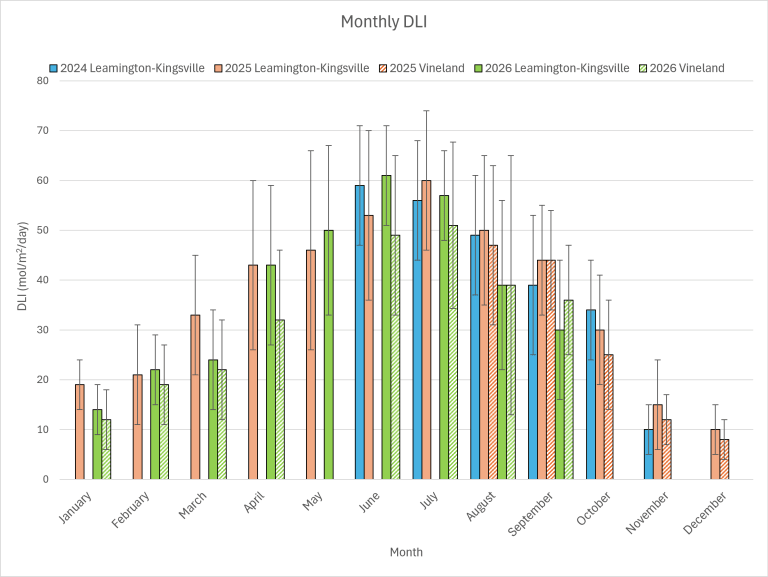
Available DLI data is presented for each month in Figure 1 and Table 1, for each week in Figure 2 and for each day (24 hr period) of the current month in Figure 3 and Table 2. It is all available to download in the attached Excel sheet in the last section.
DLI Data
Figure 1: Available monthly DLI data for Leamington-Kingsville and Vineland in 2024, 2025 and 2026 presented in two graphs. A) Bar graph representing average ± standard deviation, and B) box whisker graph representing the average (indicated by the x within the box), median (indicated by the horizontal dash within the box), 25-75% of the data (indicated by the box) and minimum and maximum values (indicated by the ends of the whiskers or outlier values above and below the box).
A)
B)

Table 1: 2025 and 2026 monthly DLI data for Leamington-Kingsville and Vineland. NA = not available.

Figure 2: Available weekly DLI data for Vineland in 2025, and 2026. Week 1 = January 1 – 7, week 2 = January 8 – 14,…,week 52 = December 24 – 31

Figure 3: September 2026, daily (24 hr period) DLI data for Vineland. Data was not available for days with no bars.

Table 2: September 2026, daily (24 hr period) DLI data for Leamington-Kingsville. Data was not available for days with empty cells.

DLI and PPFD Excel Sheets
Click the buttons below to download the Excel DLI and PPFD data sets for Leamington-Kingsville and Vineland.
Contact Us
We want your feedback!
If we can present or interpret this data in a different way that would be more beneficial to you, please let us know. If you have questions, comments or any feedback at all, please comment on this post or email:
Kyle Hendricks, Acting Greenhouse Floriculture Specialist (OMAFA)
- e: kyle.hendricks@ontario.ca
- t: 226-268-8930
Dr. Fadi Al-Daoud, Greenhouse Vegetable Specialist (OMAFA)
- e: fadi.al-daoud@ontario.ca
- t: 519-551-6703
A version of this post was posted on the OnGreenhouseVegetables Blog by Fadi Al-Daoud